VW Van Models
VW Van Models
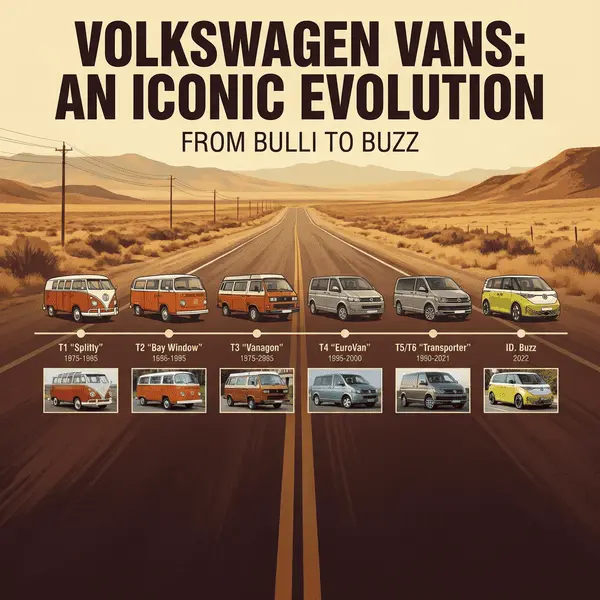
Volkswagen vans have captured the hearts of enthusiasts and adventurers for decades. From the iconic VW Vans microbus to the modern electric VW ID. Buzz, these versatile vehicles have left an indelible mark on automotive history. The evolution of VW van models reflects changing times, technologies, and consumer preferences, making them a fascinating subject to explore.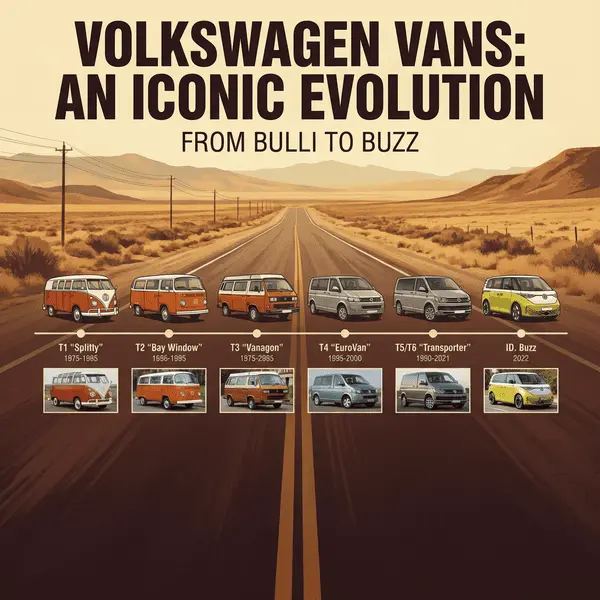
This comprehensive guide delves into the rich history of Volkswagen van models, from the classic Volkswagen Type 2 to the cutting-edge VW van 2024 designs (see our dedicated VW Kombi 2024 guide). We’ll examine the different types of VW vans, including old VW van models from the 70s and the latest Volkswagen Transporter iterations. The journey covers the beloved Volkswagen hippie van, the practical Volkswagen Kombi, and the futuristic VW ID. Buzz interior and pricing. By the end, readers will have a deep understanding of VW van models explained through the years, their cultural impact, and the exciting future of these beloved vehicles.
Volkswagen T1: The Iconic Splitscreen
T1 History
The Volkswagen T1, also known as the Transporter, emerged from the ashes of World War II. Its origins can be traced back to Ben Pon, a Dutch businessman who visited the Wolfsburg factory in 1946. Pon’s keen eye spotted a homemade parts mover called the Plattenwagen, which sparked his imagination. Inspired by this utilitarian vehicle, he sketched a concept for a versatile van.
In 1947, Pon returned to Wolfsburg with detailed drawings and specific criteria for his vision. The vehicle needed to carry a load of 1500kg and have the driver positioned at the front. Development began in 1948, and within three months, the first prototype was born.
Heinz Nordhoff, Volkswagen’s post-war boss, approved the new vehicle for production in 1949. The first T1 rolled off the assembly line in November of that year. Initially, only eight vehicles were produced, including six panels, one Kombi, and one Microbus. By the end of 1950, production had soared to over 8,000 units.
T1 Design Features
The T1’s design was revolutionary for its time. Its unique appearance featured a split windshield, which gave rise to its “Splitscreen” nickname. The van’s rounded body and distinctive V-shaped front became instant classics.
Interestingly, aerodynamics played a role in shaping the T1. Initial prototypes had poor drag coefficients of around 0.75. Through wind tunnel testing at the Technical University in Braunschweig, engineers refined the shape, reducing the coefficient to approximately 0.48 by introducing the iconic V-shape to the nose and windscreen area.
The T1’s interior was designed for maximum functionality. It featured a pop-up roof for extra headroom and sleeping space. The seats could be folded down to create a bed, and a small kitchenette area with a sink and stove was available in some models.
T1 Performance
The T1’s performance was modest but sufficient for its purpose. Early models were powered by a 1131cc air-cooled, flat-four engine mounted on a transaxle transmission. This powerplant produced 25 horsepower, which, while not impressive by today’s standards, was adequate for the van’s intended use.
To maximize the limited power, VW Vans employed an ingenious system of reduction boxes. These effectively acted as an additional gearbox, providing more torque at the expense of higher engine revs and a lower top speed.
Over the years, the T1 saw several engine upgrades:
- 1953: Engine capacity increased to 1192cc, producing 30 horsepower
- 1955: Compression ratio increased for better performance
- 1962: A heavy-duty version introduced with a 1500cc, 42 horsepower engine
- 1963: Engine further upgraded to 1493cc, producing 51 horsepower
The T1’s top speed was around 95 km/h (59 mph), with acceleration from 0 to 100 km/h (62 mph) taking about 11.9 seconds. While not built for speed, the T1 was renowned for its reliability and durability, making it a popular choice for various applications, from family vehicles to work vans and camping trips.
Volkswagen T2: The Bay Window Era
T2 History
In late 1967, Volkswagen introduced the second generation of the Type 2, known as the T2. This new model, affectionately called the “Bay Window” due to its one-piece panoramic windscreen, replaced the iconic “Splitty” and marked a significant evolution in the VW van lineup. The T2 was produced in West Germany until 1979, but its legacy continued in South America for decades.
The T2’s development was gradual, with changes implemented over several years. Early models featured rounded bumpers with a built-in step, front doors that opened to 90 degrees, and crescent air intakes in the D-pillars. As the years progressed, the T2 underwent various modifications to enhance its functionality and performance.
T2 Design Features VW Van Models
The T2 Bay Window represented a radical rethink of the VW van design. It introduced several key improvements over its predecessor:
- Ball joint front suspension replaced the king and link pin system
- Independent rear suspension (IRS) took the place of reduction boxes and swing arms
- Wind-down cab windows improved ventilation
- A “back bar” was fitted to stabilize the engine
The exterior design evolved throughout the T2’s production run. In 1972, flared front and rear wheel arches were introduced, along with taller rear lights. The year 1973 saw a significant model revamp, with square-style bumpers replacing the wrap-around design and front indicators moved up to a new grille.
Interior-wise, the T2 retained many beloved features from the T1, such as the round quarterlight knobs and ribbed armrests. However, it also introduced new elements like an updated instrument panel and improved heating systems.
T2 Performance
The T2 Bay Window saw several engine upgrades throughout its lifespan:
- Early models used the Beetle’s 1600cc air-cooled unit
- In 1971, a new 1.6L engine with dual intake ports was introduced, rated at 37 kW (50 PS)
- 1972 saw the introduction of a 1.7L flat “pancake” engine with twin carburetors, producing 66 hp
- A 68 bhp 1.8-liter option became available in 1973
- Later models offered a 70 bhp 2.0-liter version
These engines, while modest by modern standards, were sufficient for the T2’s intended use. The van’s performance was characterized by its easy-going nature rather than speed, with top speeds rarely exceeding 50 mph.
An important mechanical upgrade came in 1971 with the introduction of front disk brakes, improving the van’s stopping power. Additionally, new roadwheels with brake ventilation holes were added, enhancing overall brake performance.
The T2 Bay Window’s enduring popularity led to its continued production in Brazil until 2013, where it received modern water-cooled engines, including a 1.4-liter unit capable of running on petrol or ethanol. This longevity is a testament to the T2’s versatile design and enduring appeal among enthusiasts and camper converters alike.
Volkswagen T3: The Wedge-Shaped Wonder
T3 History
The Volkswagen T3, also known as the Type 2 (T3), marked the third generation of the legendary Volkswagen Transporter series. Its development began as early as 1973 when VW Group Chairman Rudolf Leiding decreed that the new Transporter would feature a forward control, rear-engined design. By September 1974, Gustav Mayer’s engineering team unveiled the first prototype, codenamed EA162.
Production of the T3 commenced in May 1979 at the Hannover factory, serving as a replacement for the Bay Window Type 2 van. The T3 was marketed under various nameplates worldwide, including Transporter or Caravelle in Europe, T25 in the UK, Microbus and Kombi in South Africa, Brazil, and Australia, and Vanagon in North and South America.
T3 Design Features
The T3 represented a significant departure from its predecessors, featuring a distinctive boxy shape and rear-mounted engine. Its design was characterized by:
- A more angular styling compared to the T2
- Larger and heavier build
- Improved suspension system with double wishbone front and semi-trailing arm rear configuration
- Enhanced crash protection measures
Early T3 models were easily identifiable by their twin round headlamps, pressed chrome metal bumpers with plastic end caps, and pressed vents on the rear pillars. The introduction of the wasserboxer engine in 1981 brought about design changes, including the replacement of rear vents with molded plastic covers and the addition of a second lower grille on the front to direct air through the radiator.
The T3 offered a wide variety of body variants, catering to diverse needs:
- Utility vans
- Pickups
- Campers (including the popular Westfalia conversions)
- Caravelle passenger versions
- Multivan models
T3 Performance VW Van Models
Initially, the T3 was powered by a choice of two air-cooled flat-four engines:
- 1600cc unit (CT) producing 50 hp
- 2000cc Type 4 engine (CU) generating 70 hp
In October 1981, Volkswagen introduced the water-cooled boxer engine, known as the “wasserboxer” or WBX. This new engine featured Heron combustion chambers and gear-driven cams. However, early waterboxers faced reliability issues, particularly with head gasket failures due to design flaws.
For those seeking enhanced off-road capabilities, Volkswagen produced a 4×4 version called the Syncro. Available in 14-inch and 16-inch wheel variants, the Syncro featured reinforced chassis, stronger driveshafts, and larger CV joints. While not standard, customers could opt for locking differentials to improve off-road performance.
The T3’s versatility and spaciousness contributed to its popularity among enthusiasts. A total of 1.3 million T3 models were produced in Hannover between 1979 and 1992, with South African production continuing until 2002. The T3 holds the distinction of being the final generation of rear-engined Volkswagens, marking the end of an era in the company’s van design philosophy.
Volkswagen T4: The Modern Van
T4 History
The Volkswagen T4, also known as the Transporter T4, marked a significant milestone in the evolution of Volkswagen vans. Introduced in August 1990, it represented a bold departure from its predecessors. The T4 was the fourth generation of the Volkswagen Transporter series and the first to feature a front-mounted, water-cooled engine. This revolutionary design change broke nearly all links to 50 years of heritage, signaling a new era for Volkswagen commercial vehicles.
Production of the T4 took place at the dedicated Transporter factory in Hanover, Germany. It continued for nearly 14 years, ceasing in 2003, making it the second-longest production run in its home market, surpassed only by the iconic T1. The T4’s introduction was met with initial hesitation from fans of the rear-engined Transporters, but it gradually gained popularity among various user groups, including tradesmen, motorhome owners, and leisure vehicle enthusiasts.
T4 Design Features VW Van Models
The T4’s design was a complete overhaul, incorporating modern ideas borrowed from Volkswagen’s Golf and Passat ranges. Its front-engined, front-wheel-drive layout and monocoque construction set it apart from its rear-engined predecessors. The van was available in both Short Wheel Base (SWB) and Long Wheel Base (LWB) configurations, catering to diverse needs.
The T4 range offered remarkable versatility, with various body styles including:
- Panel Van (no side windows)
- Eurovan (2 side windows, sliding door and opposite)
- Kombi (windows but no rear seating)
- Caravelle (5, 7, 8, 9 seat options)
- Single Cab Pickup
- Double Cab Pickup
- Syncro (4×4 available for all models)
A major facelift occurred in 1996, introducing several significant changes:
- Rear disk brakes
- One-piece rear bumper
- Introduction of the 2.5-liter TDi engine
- Longer nose design for Caravelle models to accommodate the VR6 engine
The T4’s versatility made it a favorite among vehicle conversion companies. It was adapted for various specialized uses, including refrigerated vehicles, police and ambulance services, taxis, and disability vehicles with wheelchair ramps. A unique variant, the Razor Back, was even developed as a brewery delivery vehicle with a lowering floor for loading and unloading beer barrels.
T4 Performance VW Van Models
The T4 offered a range of petrol and diesel engines, balancing power and fuel efficiency. Notable engine options included:
- 2.5-liter TDi engine (introduced in 1996)
- VR6 engine (necessitating the longer nose design)
The T4’s front-wheel-drive layout provided consistent handling characteristics regardless of payload, unlike rear-drive commercial vehicles. This design choice resulted in comfortable and easy-going driving dynamics, with some variants offering surprisingly sporty performance.
For enhanced off-road capabilities, Volkswagen produced the Syncro, a 4×4 version available across all models. The Syncro featured a permanent 4WD system utilizing a viscous coupling unit as a center differential to regulate torque distribution to the rear axle.
The T4’s driving experience was notably car-like, with smooth engine performance and acceptable noise levels even at motorway speeds. Even in its most basic form, the T4 demonstrated impressive fuel efficiency, with reports of achieving 42 mpg when fully loaded.
Volkswagen T5 and T6: The Contemporary Classics
T5/T6 History
The Volkswagen Transporter T5 made its debut in the UK market in 2003, marking a significant milestone in the evolution of VW vans. It brought substantial improvements to the suspension and interior, setting a new standard for medium vans. The T5’s popularity soared, becoming a common sight on UK roads and beyond.
In 2015, Volkswagen introduced the T6, building upon the success of its predecessor. This sixth generation of the iconic medium van aimed to deliver a driving experience akin to that of a car. The T6 represented 65 years of Transporter heritage, offering a more reliable, quieter, and safer ride than modified originals.
A major facelift occurred in 2019 with the introduction of the T6.1. This update brought a sharper front-end styling, featuring larger grille openings, narrower headlights, and an increased emphasis on horizontal lines. The T6.1 also introduced a model name badge on the front wings next to the new headlights, contributing to a more premium appearance.
T5/T6 Design Features VW Van Models
The T5 and T6 models share similar body dimensions, with internal and external measurements remaining largely unchanged. However, the T6 introduced several notable design improvements.
The T6’s dashboard underwent a complete redesign, aiming to create a more car-like interior feel. This redesign was supported by improvements to the driving experience and the option to add VW’s latest multimedia infotainment systems, featuring touchscreens up to 9.2 inches across.
Both T5 and T6 models offer a range of body styles, including panel van, crew van, kombi, California Camper, and Caravelle. The T6, particularly in its Highline trim, introduced modern perks such as a 5-inch touchscreen, Bluetooth connectivity, USB port, and a heated windscreen.
T5/T6 Performance
The T5 initially offered a choice of diesel engines, including a 1.9-liter PD with 85bhp or 105bhp options, and a more powerful 2.5-liter five-cylinder available in 130bhp or 174bhp variants. The latter could be paired with 4Motion four-wheel drive in its higher output version.
The T6 saw significant changes in its engine lineup due to the introduction of EU Emissions standards in 2015. It features a 2.0-liter diesel engine with power outputs ranging from 83bhp to 201bhp in the twin-turbo configuration. Petrol options are also available but less common.
Both models offer a choice between manual and automatic transmissions, with the T6 featuring an improved gear transition for a smoother driving experience. The T6 also introduced VW’s Bluemotion Technology, which helps decrease fuel consumption through features like auto start/stop and low rolling resistance tires.
The T6.1 facelift brought further mechanical improvements, including a new electromechanical power steering system. This enhancement makes the steering feel both effortless and accurate, providing light handling at low speeds without compromising high-speed stability.
Volkswagen ID. Buzz: The Electric Revolution
The Volkswagen ID. Buzz represents a groundbreaking leap into the future of electric mobility, seamlessly blending nostalgia with cutting-edge technology. This battery electric minivan, part of the Volkswagen ID. series, pays homage to the iconic Volkswagen Type 2 (T1) Microbus while embracing the demands of modern, sustainable transportation.
ID. Buzz History VW Van Models
Debuting on March 9, 2022, the ID. Buzz marks a significant milestone in Volkswagen’s journey towards electrification. It stands as the first production electric minivan from the German manufacturer, built on the dedicated MEB platform. The design, led by Klaus Zyciora, Head of Volkswagen Group Design, aimed to create a vehicle that appeals to both nostalgic enthusiasts and a new generation of environmentally conscious drivers.
ID. Buzz Design Features
The ID. Buzz’s design is a masterful fusion of retro esthetics and contemporary functionality. It retains iconic elements of the original Type 2, such as the prominent front-mounted logo and optional two-tone paint, while incorporating modern proportions and innovative technology. The interior showcases Volkswagen’s commitment to spaciousness and flexibility, with the five-seater version offering up to 1,121 liters of luggage capacity behind the second row.
Key design features include:
- Electric panoramic sunroof with switchable “Smart Glass”
- Modular interior adaptable for various business needs
- Ergonomic front dash design with ample storage compartments
- Optional seven-seater configuration with ISOFIX and Top Tether
ID. Buzz Performance
The ID. Buzz boasts impressive performance metrics, positioning it as a leader in the electric van segment. The powertrain options include:
- Short-wheelbase (SWB) version:
- Rear-axle APP 310 motor
- 150 kW (201 hp) output
- 310 N⋅m (229 lb⋅ft) torque
- Long-wheelbase (LWB) version:
- Upgraded APP 550 traction motor
- 210 kW (286 hp) output
- 550 N⋅m (406 lb⋅ft) torque
- All-wheel-drive version (available in 2024):
- Combined output of 250 kW (339 hp)
The SWB model features an 81 kW-hr battery (77 kW-hr usable), offering an estimated range of 400–480 km (250–300 mi). The LWB versions come equipped with a larger 91 kW-hr battery (85 kW-hr usable), providing an estimated range of 406–418 km (252–260 mi) on the EPA driving cycle.
Volkswagen aims to achieve a minimum range of 250 miles for the U.S. market version, which will also boast increased power (330 horsepower) and a higher top speed of 99 mph. The ID. Buzz’s fast-charging capabilities further enhance its practicality for both private and commercial use.
As Volkswagen continues to refine and expand the ID. Buzz lineup, including the introduction of the high-performance GTX model, this electric van is poised to revolutionize sustainable mobility and redefine the concept of the modern minivan.
Conclusion VW Van Models
The journey through Volkswagen van models showcases a remarkable evolution in design, technology, and functionality. From the iconic T1 Splitscreen to the electric ID. Buzz, each generation has left its mark on automotive history. These vans have not only served as practical vehicles but have also become cultural symbols, embodying the spirit of adventure and freedom.
Looking ahead, the future of Volkswagen vans seems bright and electrifying. The ID. Buzz represents a bold step into sustainable mobility, blending nostalgic charm with cutting-edge technology. As Volkswagen continues to innovate, we can expect to see more groundbreaking features and eco-friendly solutions in their van lineup. This ongoing evolution ensures that Volkswagen vans will keep capturing hearts and meeting the changing needs of drivers for generations to come.
FAQs VW Van Models
1. How far can the VW ID Buzz van travel on a single charge?
The VW Van Models VW ID Buzz van can travel up to 257 miles without needing to recharge, making it an eco-friendly and robust fully-electric vehicle.
2. What distinguishes the VW ID Buzz Life from the VW ID Buzz Style?
The VW Van Models ID Buzz Life features 19-inch “Tilburg” alloy wheels and 10-color ambient lighting, whereas the ID Buzz Style is equipped with 20-inch “Solna” alloy wheels, 30-color adaptive interior ambient lighting, and additional tailgate surround lighting, offering more customization options.
3. Does the ID. Buzz use the VW MEB platform?
Yes, the VW Van Models ID. Buzz utilizes the Volkswagen MEB platform. This model, which launched on March 9, 2022, is among nine new Volkswagen models that are based on this platform.
4. What seating options are available in the VW ID Buzz?
The VW ID Buzz offers flexible seating arrangements with three rows that can accommodate six or seven passengers, providing ample space for a large group.