Are Bull Bars Legal in Europe
Are Bull Bars Legal in Europe
Are Bull Bars Legal in Europe? the sturdy metal structures fitted to the front of vehicles, have been a topic of debate in Europe for years. Their use has an impact on road safety, particularly for pedestrians and cyclists, leading to questions about their legality across the continent. As vehicle modifications continue to evolve, it’s crucial to understand the current stance on bull bars in Europe and how it affects road users, insurance coverage, and overall vehicle safety.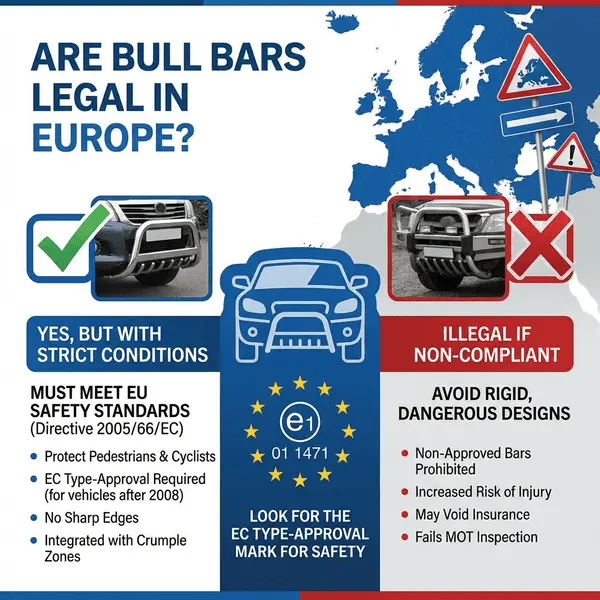
This guide delves into the legal status of bull bars in the European Union, exploring country-specific regulations and exceptions. It examines the role of organisations like the European Automobile Manufacturers Association (ACEA) and the European Safety Council in shaping policies. The article also looks at the influence of Euro NCAP ratings on bull bar usage and addresses common queries such as “Are bull bars legal in the UK?” and “Are bull bars illegal in the UK?” By the end, readers will have a clear understanding of the rules surrounding bull bars for cars in Europe and the factors to consider when thinking about installing them.
Legal Status of Bull Bars in the European Union
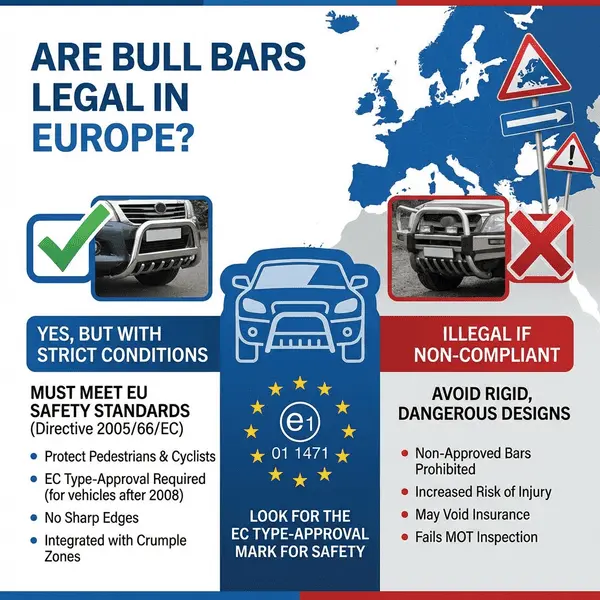
The European Union has implemented strict regulations regarding the use of bull bars, also known as frontal protection systems, on vehicles. These regulations aim to enhance road safety, particularly for pedestrians and other vulnerable road users.
EU Directive 2005/66/EC
The EU Directive 2005/66/EC sets forth technical requirements for frontal protection systems. This directive stipulates that manufacturers must ensure that bull bars, whether fitted as original equipment or supplied as separate technical units, comply with specific safety standards. The directive focuses on improving the frontal structures of vehicles to reduce the severity of injuries to pedestrians and vulnerable road users, especially in collisions at speeds under 40 km/h.
Pedestrian safety concerns Are Bull Bars Legal in Europe
Bull bars have an impact on pedestrian safety, as they can increase the risk of severe and fatal injuries in the event of a collision. Research indicates that vehicles fitted with bull bars, particularly those without deformable padding, concentrate crash forces over a smaller area of vulnerable road users compared to vehicles without bull bars. Rigid bull bars made from steel or aluminium stiffen the front end of vehicles and interfere with the vital shock absorption systems designed into vehicle fronts, significantly altering collision dynamics.
Implementation across EU member states
The implementation of the EU directive has led to restrictions on the sale of bull bars within the European Union. However, it’s important to note that the possession and use of bull bars are not explicitly prohibited. The technical requirements laid down for frontal protection systems are part of a broader initiative to protect pedestrians and other vulnerable road users, aligning with the European Commission’s Road Safety Action Programme to halve the number of road accident victims by 2010.
These regulations reflect the EU’s commitment to improving road safety and reducing the risk of severe injuries to pedestrians and cyclists. As a result, bull bars sold in the EU must meet specific safety standards to minimise their potential impact on vulnerable road users in the event of a collision.
Country-Specific Regulations
UK Regulations
In the UK, bull bars are legal as long as they comply with EU standards. The government website states that bull bars should only be fitted if they meet certain safety standards. These standards include specifications for materials and design to minimise injuries. It is an offence to sell bull bars that are not approved according to the regulations set by the EU in 2007. Approved bull bars should have an official mark and certification to show they meet the necessary safety standards. However, it is illegal to fit an aftermarket bull bar that doesn’t meet the standards set out in the UNECE Regulation 73, which covers lateral protection devices.
German Regulations
While specific German regulations are not mentioned in the provided information, it’s important to note that Germany, as an EU member state, follows the EU Directive 2005/66/EC. This directive sets technical requirements for frontal protection systems, including bull bars. German authorities enforce these regulations to ensure road safety and pedestrian protection.
French Regulations
France, like other EU countries, adheres to the EU regulations regarding bull bars. The use of metal bull bars has been restricted since May 25, 2007. Vehicles manufactured before this date may still have metal bull bars, but those produced after can only be fitted with soft A-bars. It’s worth noting that if a vehicle is road legal in its country of registration, it is generally considered legal as a visiting vehicle in France and other European countries.
Italian Regulations Are Bull Bars Legal in Europe
Italy follows the EU regulations on bull bars. Some Italian companies, such as Misutonida, have been producing EU-compliant bull bars for over 25 years. These products are designed to meet the safety standards required by EU regulations, focusing on high-quality materials and design that prioritise pedestrian safety. Italian-made bull bars often come with comprehensive fitting kits, including bolts or plates that ensure flexibility in the event of a collision, adhering to the EU’s safety requirements.
Exceptions and Special Considerations
Vehicles registered outside the EU
Vehicles registered outside the European Union may face challenges when entering EU countries with bull bars installed. For instance, a highly modified Toyota Tacoma registered in Oregon, USA, with a CBI aluminium winch bumper, might encounter issues at customs. While these vehicles are legal in their country of origin, they may not comply with EU regulations on pedestrian safety. Travellers planning to bring such vehicles into Europe should be aware that bull bars have been restricted for about a decade due to safety concerns.
Classic and vintage vehicles
Classic and vintage vehicles often fall under special considerations when it comes to bull bars. While the regulations do not explicitly mention exceptions for older vehicles, it’s worth noting that cars manufactured before the implementation of the EU directive in 2007 may still have metal bull bars. However, owners of classic vehicles should check with local authorities to ensure compliance with current regulations.
Off-road and agricultural use
Off-road vehicles and those used in agriculture often require additional protection, which is where bull bars can play a crucial role. Farmers and forestry workers, for example, may need to preserve their vehicles from accidental impact with fence posts and livestock. In these cases, the use of bull bars might be permitted, provided they meet certain safety standards.
It’s important to note that any bull bars fitted to vehicles must not be rigid, as this type was banned by the EU in 2007. Approved bull bars should have an official mark and certification to show they meet the necessary safety standards. These standards include specifications for materials and design to minimise injuries in case of a collision with pedestrians or cyclists.
For those considering installing bull bars, it’s crucial to ensure they comply with UNECE Regulation 73, which covers lateral protection devices. Selling or fitting non-compliant bull bars is an offence in EU countries. Users should be aware that while bull bars may offer vehicle protection, they can also interfere with crumple zones and airbag deployment, potentially increasing the risk of injury to vehicle occupants in a collision.
Conclusion
The legal status of bull bars in Europe has a significant impact on road safety and vehicle modifications. EU regulations have put strict measures in place to protect pedestrians and cyclists, leading to the development of compliant bull bars that meet safety standards. While these rules apply across the EU, there are some variations in how different countries implement them. This means that drivers need to be aware of the specific requirements in the countries they plan to visit.
For those considering installing bull bars, it’s crucial to ensure they meet the necessary safety standards. This is especially important for vehicles registered outside the EU, classic cars, and those used for off-road or agricultural purposes. By following these guidelines, drivers can help to make roads safer for everyone while still protecting their vehicles. In the end, the goal is to strike a balance between vehicle protection and the safety of all road users.
FAQs Are Bull Bars Legal in Europe
Are bull bars permitted across Europe?
Yes, bull bars, including nudge bars, frontal protection, front bars, and A-Bars, are legal in Europe provided they comply with EU regulations. Since 2007, the EU has prohibited the use of rigid bull bars on vehicles.
Is it legal to have bull bars on cars in the UK?
In the UK, fitting bull bars on vehicles is not illegal. However, they must not pose an increased risk to passengers, pedestrians, or other road users to be considered legal.
Can one install a bull bar on a vehicle in the UK?
Yes, it is legal to install bull bars on vehicles in the UK. However, it’s crucial that these bull bars adhere to specific safety standards as outlined on the government’s website.
Why are bull bars not fitted on UK police cars?
UK police cars do not feature bull bars primarily due to the significant number of deaths and serious injuries they have been associated with. Rigid car fronts, often equipped with metal bull bars, have been linked to approximately 2,000 deaths and 18,000 serious accidents annually across Europe. Consequently, the sale of new metal bull bars that fail to meet the European Union Directive standards was banned.